
This post has been forming for a while now – shaped by a conversation last night, some lingering research, and a post I read from the Clergy Coaching Network (CCNet)that read earlier this week I haven’t been able to shake.
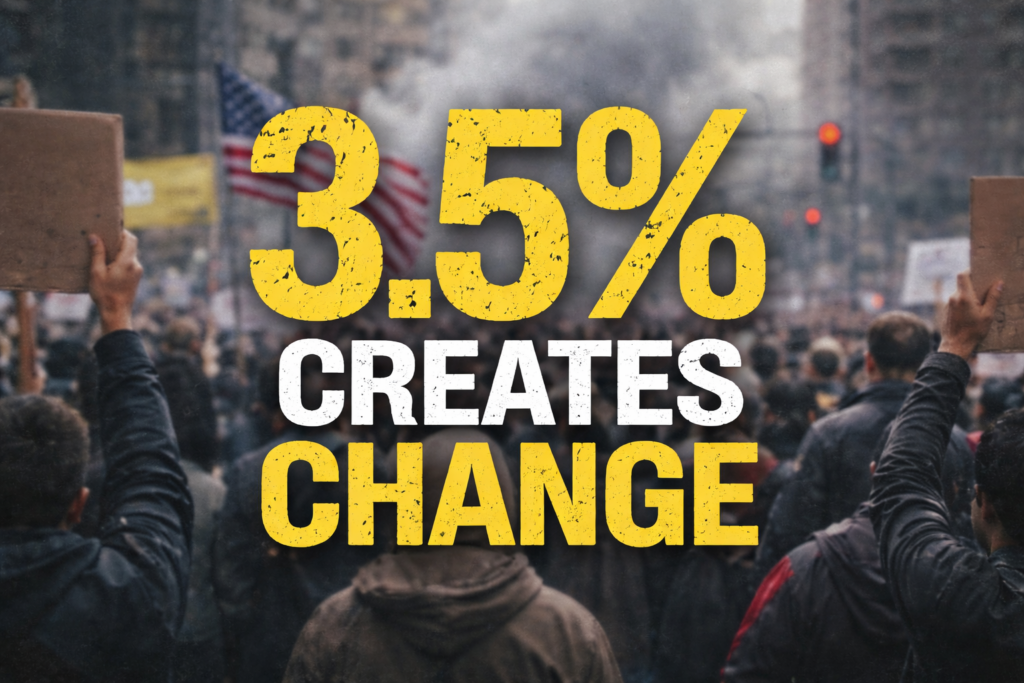
The conversation was about the 3.5% rule – the idea that when roughly 3.5% of a population engages in sustained, visible action, meaningful change becomes not just possible, but likely. It’s something I had read before maybe even talked about on my socials – The research is often framed around political movements. But the more I sit with it, the more convinced I am that this isn’t just about politics.
It’s about societal change.
And maybe—quietly, uncomfortably—it’s about the church.
What keeps catching my attention is this: the 3.5% rule isn’t about belief. It’s about action.
Not shared values.
Not internal agreement.
Not even moral certainty.
It’s about people showing up. Again and again. In public. In ways that interrupt what’s normal, comfortable, and safe.
Around the same time, I read a post from the Clergy Coaching Network responding to the criticism, “CCNet FORUM has become too political.” That critique is familiar. Many of us in ministry hear some version of it whenever faith brushes up against public life.
For years, people of faith have been encouraged – often sincerely – to avoid politics in the name of unity or neutrality. I understand that impulse. I’ve lived there for years! My personal political views are mine – not the church’s! Many of us have chosen silence at different moments, hoping it would preserve peace or keep communities together.
But as the CCNet post named so clearly: the reality we face now no longer allows the luxury of disengagement.
When policies shape the lives of the vulnerable, when truth is distorted, when cruelty is normalized, when dignity is selectively protected—silence itself becomes a moral choice. Not a neutral one.
Scripture has never treated faith as a private affair. The prophets spoke directly to kings. Jesus confronted systems of power that exploited the poor and burdened the weak. The early church refused to separate worship from justice, compassion, and truth.
James doesn’t mince words: “Faith by itself, if it has no works, is dead” (James 2:17). Faith that never shows up, never takes shape in action, never risks embodiment—it isn’t faith as Scripture understands it.
Jesus says something similar in Matthew 7: people are known by their fruit, not their intentions. Not by what they claim to believe, but by what their lives actually produce.
Which brings me back—again—to the church.
The church is often very good at belief. At statements. At resolutions. At carefully worded positions. We know how to articulate values. But the witness of the church has never been rooted in how well we agree. It has always been rooted in whether we show up.
The early church didn’t change the world because it held the right ideas. It changed the world because it lived differently—visibly, collectively, persistently. People showed up for the sick when others fled. They shared resources when scarcity ruled. They refused to disappear when power told them to stay quiet.
Belief mattered. But action gave belief credibility.
The Clergy Coaching Network was clear about something else that feels important to name here: showing up is not about promoting a political party, baptizing an ideology, or telling people how to vote. Our loyalty is not to the left or the right. Our loyalty is to Jesus and the kingdom of God.
And that kingdom has public consequences.
Silence in a moment marked by deep division, rising extremism, attacks on democratic norms, and rhetoric that dehumanizes whole groups of people is not neutrality—it is surrendering the public square to voices that do not reflect the way of Jesus.
At the same time, showing up doesn’t mean claiming moral perfection. It requires humility. We will miss the mark. We will choose words poorly. We will say things that land harder than we intended. We will offend people we care about. When that happens, the work is not retreat—but listening, learning, repenting, and growing together.
The goal isn’t to inflame anger, but to form conscience.
Not to divide, but to disciple.
Not to chase power, but to bear faithful witness.
The 3.5% rule presses a question the church can no longer avoid:
not what do we believe? but where are we willing to show up?
Not once.
Not symbolically.
But consistently.
In bodies.
In public.
Over time.
Because real change—societal change, spiritual change, kingdom-of-God change—has never required everyone. It has always required a faithful few willing to show up and stay.
And maybe that’s the invitation before us now: not comfort, not certainty, but faithful presence in hard times.
https://www.bbc.com/future/


Leave a Reply