
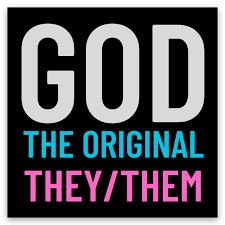
I’ve had a couple of discussions lately about what we call God. So this morning, I decided to put pen to paper, more accurately fingers to keyboard, and offer some thoughts on why I Avoid Masculine Pronouns for God and Rarely Call God “Father”
I’m deeply rooted in the Christian tradition. I fully recognize that Scripture contains many references to God as Father. Yet I intentionally avoid using masculine pronouns for God and rarely address God as “Father.” This choice is not a rejection of Christianity, nor is it an attempt to erase biblical language. Rather, it arises from a conviction that God transcends human gender and that no single image or metaphor should be mistaken for the fullness of the divine mystery.
I grew up in a world where God’s masculinity was prominent in teachings, and yet there was occasionally when pressed a religious leader in my circle, who would say they believe God isn’t a man in the way humans think of men because God isn’t human. I was already thinking about God and genderfying God when I started seminary in 2016, but the real change in my language came when I took a class taught by Dr Joanne Terrell, womanist theologian, and any use of male pronouns or words resulted in a diminished grade (I had no points to spare). I learned quickly to adjust my language and then it began to feel correct to me to use God for God without embellishment.
I absolutely love that our Jewish friends, use so many names for God. In Judaism, God has multiple names because they act as descriptive titles that reveal a specific attribute, function, or relationship with humanity, rather than just being personal labels. Out of extreme respect, Jews treat God’s primary name (YHWH) as too holy to pronounce or casually write. To avoid misusing the name—violating one of the Ten Commandments—Jews substitute it with spoken titles like Adonai (meaning “My Lord”) or Hashem (meaning literally “The Name”). Frankly, I love this – the name!
But, on to why I’m avoiding male language for God. My first reason is theological. God is spirit (John 4:24), not a biological male. Human beings are created in God’s image, both male and female (Genesis 1:27), which suggests that neither masculinity nor femininity alone can adequately represent God. To speak of God exclusively as “he” risks implying that maleness is somehow closer to the divine. Christian theology has long affirmed that God is beyond human categories, including gender. Even traditions that strongly retain the title “Father” acknowledge that God is not literally male. The Methodist Church of Great Britain stated that “God is NOT male” and that father language is metaphorical rather than literal.
Second, Scripture itself provides a rich variety of images for God. God is compared to a mother comforting her child (Isaiah 66:13), a woman searching for a lost coin (Luke 15:8-10), a mother eagle (Deuteronomy 32:11), and a woman in labor (Isaiah 42:14). Divine Wisdom (Sophia) is personified in feminine language throughout Proverbs. These images remind us that biblical language about God is diverse and symbolic. No single metaphor captures the fullness of God’s being.
Third, I believe that language shapes imagination. When Christians use only masculine titles and pronouns, it becomes easy to unconsciously equate God with maleness. Catholic theologian Elizabeth Johnson argues that exclusively male images have often been taken too literally and have reinforced patriarchal assumptions. She contends that male and female symbols are equally appropriate—and equally inadequate—because God always exceeds human language. Inclusive language helps recover the mystery of God and prevents us from turning our metaphors into idols.
My hesitation with the title “Father” is not because I believe the image is wrong. Rather, I believe it is one image among many. Jesus used “Father” or probably more accurately “daddy” to describe his intimate relationship with God, and I honor that language. However, I do not believe that Jesus intended this metaphor to exclude all others. To insist that one image is the only acceptable way to speak of God risks elevating a metaphor above the reality to which it points. The church’s language should be expansive enough to reflect the many biblical ways God is revealed.
Pastor and theologian Richard Floyd has written that while God is not male, congregations benefit from using a wider range of biblical images and minimizing exclusively masculine language. Such diversity reminds believers that God is always greater than our words and images.
Ultimately, my goal is not to replace one rigid vocabulary with another. I do not insist that others abandon the language of “Father,” nor do I claim that masculine imagery has no place in Christian faith. Instead, I seek a richer and more faithful way of speaking about God – one that honors Scripture’s many metaphors and acknowledges that the Holy One surpasses every human category.
In scripture, God is Creator, Redeemer, Sustainer; Shepherd, Rock, Wisdom, Mother Hen, Breath, Fire, Living Water, and Love. God is not confined to human gender, and therefore I choose language that points beyond gender rather than language that unintentionally limits the One who is beyond all naming.
References
Johnson, Elizabeth A. She Who Is: The Mystery of God in Feminist Theological Discourse. Crossroad Publishing, 1992.
The Methodist Church of Great Britain. Inclusive Language and Imagery About God, 1992.
Floyd, Richard. “. . . and to the Son.” 2009.
Johnson, Elizabeth. “A Theological Case for God-She.” Commonweal, January 29, 1993.


Leave a Reply