
A friend posted something on Facebook this morning that sent me down a rabbit hole.
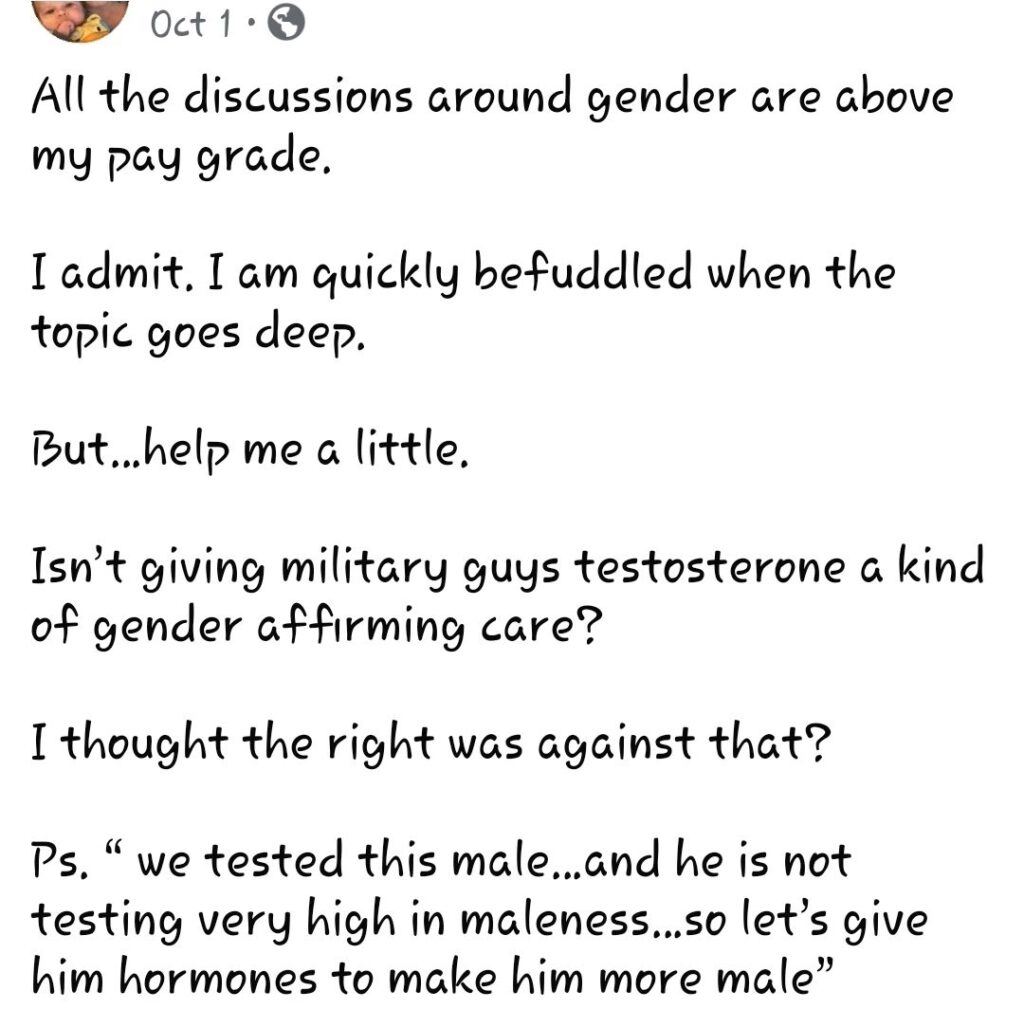
They began by admitting that a lot of the conversations around gender can get complicated pretty quickly. Fair enough. But then they asked a wonderfully simple question: If the military tests a man, decides his testosterone is too low, and gives him testosterone so that his body more closely conforms to what we expect of a male body, isn’t that gender-affirming care?
Well, that’s an interesting question.
Because the Pentagon is moving forward with testosterone-deficiency screening for many male service members. And medically speaking, diagnosing and treating an actual hormone deficiency isn’t some bizarre new idea. There can be perfectly legitimate medical reasons to test testosterone and, when appropriate, treat low levels. That’s not really the part that makes me uncomfortable.
It’s the cultural context surrounding it.
This is happening in an administration that has spent enormous political energy opposing gender-affirming care for transgender people, including within the military. At the same time, we’re talking about measuring testosterone in male troops while our Defense Secretary talks repeatedly about warriors, toughness, male physical standards and restoring a particular kind of military culture.
That’s where this starts feeling, well, a little skeevy to me. Because apparently hormones aren’t necessarily the problem. Gender affirmation isn’t even necessarily the problem. The interesting question becomes: whose gender are we comfortable affirming?
If a transgender person receives hormones so their body better reflects their gender, we’re told this is dangerous gender ideology. But if a cisgender man has clinically low testosterone and receives hormones that reinforce traditionally masculine physical characteristics, that’s medicine. To be clear, those aren’t medically identical situations, and pretending they are wouldn’t help the conversation. But culturally, the contrast is fascinating, because underneath all of this seems to be a much bigger conversation about what we think a man is supposed to be.
And after everything we’ve been talking about this week surrounding the horrific allegations at Cornell, I can’t help thinking about that too.
A former Cornell student has alleged that she was sexually assaulted by multiple members of a fraternity while severely intoxicated and after being given drugs. The men have not been criminally convicted, several have denied wrongdoing, and the case is again under investigation. Whatever ultimately happens legally, the allegations themselves force us to wrestle with something much larger than one fraternity or one university: the culture of masculinity we create, reward and pass along.
Because misogyny doesn’t appear from nowhere. Neither does sexual violence. Neither does the idea that women exist for male consumption, or that a man’s status among other men is somehow enhanced by sexual conquest, physical dominance, aggression or humiliation. Those ideas are taught—sometimes explicitly, but far more often culturally.
That’s why I think our national obsession with performing masculinity deserves some scrutiny.
There is nothing wrong with being strong. Nothing wrong with muscles. Nothing wrong with testosterone. Nothing wrong with competition, physical courage, or being extraordinarily good at carrying heavy things. The problem comes when we begin confusing those things with manhood itself—when strength becomes domination, confidence becomes entitlement, toughness means emotional numbness, sexual conquest becomes proof of masculinity, compassion becomes weakness, and vulnerability becomes feminine and therefore undesirable.
Perhaps most dangerously, it happens when other men become the audience before whom masculinity must constantly be proven.
That’s not healthy masculinity. That’s a prison. And women often pay a terrible price for it. So do men.
Which brings me back to the Pentagon. I don’t particularly want my government deciding there is a biochemical measurement of whether a man is sufficiently masculine. Testosterone is a hormone, not a moral virtue. It doesn’t measure courage, leadership or integrity. It doesn’t measure whether someone will protect the person standing beside them. And it certainly doesn’t measure whether someone understands that real strength sometimes looks like restraint, tenderness, accountability and respect for another person’s boundaries.
Maybe that’s the conversation underneath all these seemingly unrelated stories. We’re spending enormous amounts of cultural energy policing gender while rarely stopping to ask what kind of gender culture we’re actually creating.
My own senator, Thom Tillis, who is leaving office, said this week that his vote to confirm Pete Hegseth is the biggest regret of his Senate career. And that leaves me with questions. Is what we’re seeing simply a debate about military readiness? Is it power run amok? Hubris? Or are we watching a much broader cultural anxiety about masculinity—a need to continually demonstrate who is tough enough, strong enough, aggressive enough, male enough?
I don’t know. And I’m not interested in speculating about anyone’s sexuality or testosterone level. That’s actually part of the point. A person’s masculinity isn’t mine—or the government’s—to diagnose from the outside.
But I do think we need to talk seriously about the kind of masculinity our culture rewards. Masculinity itself isn’t the enemy. Men aren’t the problem. Misogyny is. Entitlement is. Domination is. A culture that teaches boys and men that their worth depends upon proving their power over somebody else is a problem.
And perhaps instead of spending so much time worrying about whether someone is masculine enough, we’d be better served teaching a different measure of strength. Can you respect another person’s humanity? Can you hear no? Can you exercise power without abusing it? Can you be strong enough to be gentle? Can you stand among other men and refuse to participate when a woman is being degraded? Can you walk away from the crowd when the crowd is wrong?
Frankly, those sound like pretty good qualifications for a warrior.
They also sound like pretty good qualifications for a human being.
Interesting times, indeed.


Leave a Reply