
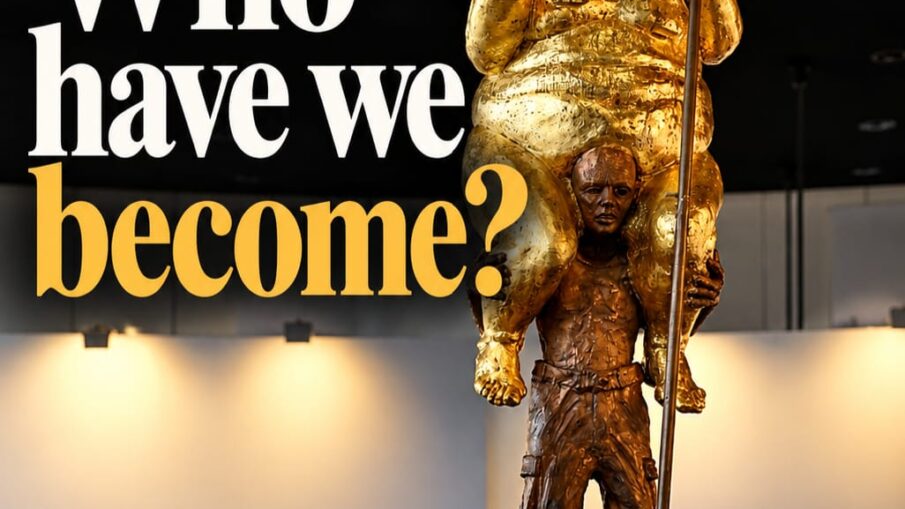
There are days when I read the news and find myself asking a question that is becoming far too familiar: Who have we become? Who have we, the United States of America, become?
Not who are we becoming. Who have we already become?
Today, October 9, I read a Reuters report that the United States has imposed additional sanctions on the International Criminal Court (ICC). The announcement came just hours after a former international judge was recognized with the Nobel Peace Prize.
Let that sink in.
On a day when the world was celebrating work associated with human rights and international justice, the United States was announcing measures against an institution established to hold perpetrators of genocide, war crimes, and crimes against humanity accountable.
The administration argues that the ICC threatens American sovereignty and has unfairly targeted American and Israeli personnel. And there are legitimate questions to debate about international jurisdiction, national sovereignty, and the authority of courts over countries that have not joined them. The United States, after all, has never ratified the treaty establishing the ICC.
But surely there is a difference between debating the jurisdiction of a court and imposing sanctions that interfere with its ability to function.
What troubles me is the message we are sending to the world. That accountability is important, provided it applies to someone else? That international law matters, unless our allies or our own citizens might be investigated? That justice is something powerful nations get to define for everyone else?
Because justice that only applies to the powerless isn’t justice. It’s power dressed up in judicial robes.
And this isn’t happening in isolation.
Earlier this year, the United States stood alone in opposing an international agreement addressing women’s rights through the United Nations Commission on the Status of Women. Thirty-seven countries supported the measure, six abstained, and the United States cast the only opposing vote.
Our representatives objected to language involving gender, sexual and reproductive health, and other social issues. Those objections should be understood accurately, but I cannot help wondering what it says about our priorities when we find ourselves standing alone against an international effort intended to advance the rights and well-being of women.
And then there was March 25, 2026.
The United Nations General Assembly voted on a resolution recognizing the trafficking and racialized chattel enslavement of Africans as the gravest crime against humanity. One hundred twenty-three countries voted in favor. Fifty-two abstained. Only three voted against it: the United States, Israel, and Argentina.
The American delegation objected in part to the resolution’s approach to historical responsibility and reparations. I understand that acknowledging an atrocity and agreeing on the legal or financial implications of that acknowledgment are not necessarily the same thing.
But as someone who believes repentance requires more than simply admitting that something terrible happened, I find that vote deeply troubling.
Slavery was not merely an unfortunate chapter in our history. It was a system of human exploitation, racial violence, stolen labor, and generational trauma whose consequences remain with us.
And the Church was complicit. Christians used Scripture to justify slavery, defended the institution from pulpits, and blessed a system that denied the image of God in other human beings. My own United Methodist tradition carries the history of a denomination that divided over slavery. That is not ancient history disconnected from who we are. It is part of the story we have inherited.
We cannot undo that history. But surely we can tell the truth about it.
Repentance without truth is just an apology designed to make the person offering it feel better.
And now, when the international community asks us to confront the gravity of that history, we seem more interested in arguing over the implications of acknowledging it.
What happened to moral leadership? What happened to the idea that our nation’s greatness should be measured not simply by our wealth, our military strength, or our ability to impose our will, but by our willingness to defend human dignity, even when doing so is uncomfortable or costly?
And then, as if the news itself weren’t providing enough material for reflection, I saw the video of a satirical sculpture called The Orange Plague, displayed at the European Parliament in Strasbourg.
 It is a deliberately grotesque depiction of POTUS as an oversized, naked, gold-colored figure perched on the shoulders of a much smaller man. In his hands are the scales of justice and a golf club.
And y’all, the symbolism is hard to miss.
The exaggerated golden body mocks vanity, wealth, and the glorification of political power. The smaller man beneath him suggests the people who must carry the weight of that power. The golf club evokes privilege and leisure, while the scales of justice raise a particularly uncomfortable question: Does POTUS see justice as something to which he must submit, or something he gets to hold and control?
The sculpture is satire. It is supposed to be absurd, exaggerated, and uncomfortable. Political satire has a long history of using ridicule to expose what artists perceive as the excesses of those in power. We can debate whether the depiction is fair, tasteful, or effective. But we should at least consider the question it raises.
What happens when a leader becomes so elevated in the public imagination that accountability itself begins to look like an insult?
And what happens when a nation begins to behave as though the rules it expects others to follow are optional for itself?
I find the image particularly striking alongside the sanctions against the ICC and our recent votes at the United Nations. Whether one agrees with the artist’s interpretation or not, the sculpture presents a powerful image of political leadership that is elevated above others rather than accountable to them.
And I cannot help contrasting that image with Jesus.
Here is a sculpture of a powerful man being carried on another person’s shoulders. And here is Jesus, kneeling to wash the feet of his disciples.
One image portrays power as something that elevates a person above others. The other reveals leadership through humility and service.
And I wonder which understanding of leadership we have come to celebrate.
As a Christian, I keep returning to the prophet Micah: “What does the Lord require of you but to do justice, and to love kindness, and to walk humbly with your God?” (Micah 6:8).
Not do justice when it benefits us. Not love kindness when it’s politically convenient. Not walk humbly while demanding that the rest of the world bow to our power.
Justice. Mercy. Humility.
Those aren’t suggestions for when things are going well. They are the measure of our faithfulness, especially when we have power.
And Jesus, who lived under the occupation of the Roman Empire, knew something about what happens when governments begin to believe their power places them beyond accountability. His ministry consistently challenged the assumption that might makes right. He centered the poor, welcomed the excluded, confronted religious hypocrisy, and exposed the cruelty that can hide beneath the language of law and order.
The cross itself reminds us what happens when political power and religious certainty join forces to silence someone who threatens the established order. The Roman Empire made a public spectacle of execution, using violence not only to punish but to communicate who held power and what happened to those who challenged it.
And the Church has spent two thousand years proclaiming that the empire did not get the final word.
Yet I wonder how often we Christians have become so invested in protecting our preferred political leaders that we’ve forgotten whom we actually claim to follow.
We have confused national loyalty with faithfulness. We have mistaken dominance for strength. And too often, we have treated accountability as persecution whenever it reaches someone we support.
And I want to be clear that this isn’t simply a question about one president or one administration. The United States has a long and complicated history of claiming moral leadership while failing to live up to its own ideals. Administrations of both parties have wrestled with international accountability, sometimes defending human rights abroad while resisting scrutiny at home.
Our history includes slavery, segregation, the displacement of Indigenous peoples, wars, and countless injustices. But our history also includes people who refused to accept those things as the final word. People who insisted that we could become something better. People who understood that loving one’s country does not require pretending it has done no wrong.
In fact, I would argue that genuine love of country requires the willingness to tell the truth about it.
That’s the America I want to believe in.
Not an America that never makes mistakes, but one willing to acknowledge them. Not a nation beyond criticism, but one strong enough to receive it. Not a country that demands immunity from justice, but one that understands that justice must be bigger than any single nation.
And there is another theological word that keeps coming to mind: idolatry.
We tend to think of idolatry as bowing before golden statues. But biblical idolatry is much bigger than that. It happens whenever we elevate something created into the place that belongs to God alone. It happens when we make an ultimate authority out of our nation, our political identity, our wealth, or our leaders.
And perhaps that is why the golden figure in The Orange Plague feels so theologically provocative to me. It calls to mind the golden calf in Exodus, when people grew anxious and impatient and fashioned something visible and powerful that they could worship.
The problem wasn’t simply that the calf was made of gold. The problem was that the people had confused something they created with the God who had liberated them.
I wonder whether we have done something similar with our understanding of national greatness.
Have we confused being powerful with being righteous? Have we mistaken wealth for blessing? Have we elevated political leaders to the point that questioning them feels like questioning God?
Because the God of Scripture is not particularly impressed by empires, golden idols, or displays of dominance.
The prophets repeatedly remind us that God is concerned with justice, with the treatment of the vulnerable, with the integrity of our communities, and with whether our worship is reflected in how we live.
Amos declares that God desires justice to roll down like waters and righteousness like an ever-flowing stream. Isaiah calls people to seek justice, rescue the oppressed, defend the orphan, and plead for the widow. Jesus tells his followers that whatever they do for the least of these, they do for him.
None of those instructions includes an exemption for national interest.
None suggests that power makes us immune from accountability.
And none allows us to substitute patriotic enthusiasm for the difficult work of loving our neighbors.
Who have we become?
I keep asking that question because I still care deeply about who we are. I still believe human rights matter. I still believe international cooperation matters. I still believe that justice, even imperfect justice, is worth pursuing. And I still believe the United States can contribute something good and meaningful to the world.
But that requires us to be willing to examine ourselves with the same moral seriousness we demand of others.
Perhaps the more important question is whether we still have the courage, humility, and moral imagination to become something better.
Because I believe repentance is possible. For individuals, for churches, and even for nations.
But repentance is not simply feeling bad about what we’ve done. It requires truth-telling, accountability, changed behavior, and the willingness to repair what has been broken.
And for those of us who claim to follow Jesus, it begins with refusing to confuse the kingdom of God with the ambitions of any earthly nation or leader.
We don’t have to agree on every international resolution, every court ruling, or every political decision to agree that human dignity matters and that no one should be above accountability.
So perhaps our invitation today is to resist the temptation to defend every action taken in our nation’s name. To read beyond the headlines. To listen to those whose experiences challenge our assumptions. To demand consistency in our commitment to human rights, whether the people involved are our allies, our adversaries, or ourselves.
And to remember that the measure of greatness Jesus offers is not how many people carry us on their shoulders, but how willing we are to kneel and wash their feet.
Who have we become?
I don’t know that I like the answer.
But I haven’t given up believing we can become better.
And right now, we have some truth-telling to do.


Leave a Reply